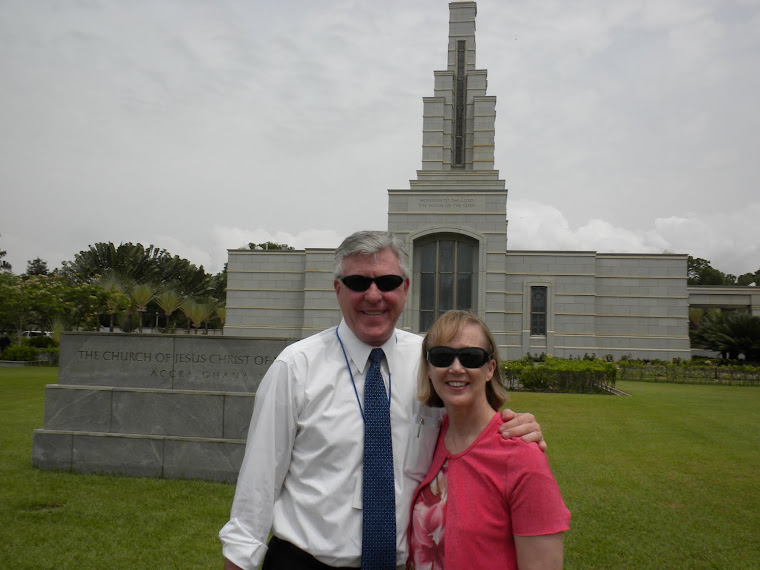
Accra Ghana Temple

Accra Ghana Temple
Accra Ghana Temple

Saturday, September 4, 2010

Elmina Slave Castle

During our recent trip to Cape Coast and Elmina, we visited the very sobering Elmina Slave Castle.  The white-washed, red-roofed castle with its many cannons facing the sea sits right on the ocean.  The grand scale and picturesque views belie the horrors that took place there.  This is oldest and largest of many slave castles that exist along the Gulf of Guinea (also known as the Slave Coast).   

Elmina was built on sedimentary rock believed to be over a hundred meters deep, thus explaining why it is in such good condition today.  The castle was isolated from the community with moats, over which spanned a drawbridge, allowing no one to enter of leave the castle when lifted.  The Portuguese built Elmina Castle in 1482 as a trading post to house goods bartered (like guns, ammunition, tobacco, alcohol, and spices) for local gold and ivory.  As the demand for slaves developed in South America (Brazil), the Caribbean Islands, and America, the castle began to store a more precious and perishable trade - African human slaves. 

Millions of Africans were taken into slavery between the 1500s and 1800s.  The slaves were traded or sold to Europeans sometimes by their own chiefs, by a victorious warring tribe, or native African raiders.  Elmina castle could hold 600 men and 400 women and children (over age 12) for months at a time, waiting for the ships to arrive.  The cramped conditions had to be atrocious. 

The most sobering location in the castle was the "Door of No Return."  A barred door opens to reveal a narrow opening, only wide enough for one slave at a time to fit through sideways.  As they left the castle on small boats bound for the ship, this would be their last view of Africa, their homeland.  Half died on the voyage, but none ever returned.  It is hard to believe what humans can do to each other.

Sunday, August 29, 2010

Road Trip to Cape Coast

This weekend we made our first road trip out of Accra to the resort town of Cape Coast and the neighboring fishing village of Elmina.  This is a very lush green area of Ghana with picturesque villages and beaches.  The real adventure of the trip relates to the lack of road signs for highways and streets.  There were signs identifying most of the villages, which was the only clue.  

Getting to our hotel was a bit unnerving to say the least.  After driving through the small fishing village of Elmina, the paved roads with potholes came to an end.  As we followed the red dirt road with high vegetation on both sides, we asked ourselves, "could this be right?"  Then we saw a sign directing us to our hotel and made the poor assumption that we were almost there.  WRONG.  Just as we were about to turn around thinking that if there was a hotel out here, we weren't sure we would stay at it - we found a very lovely and new hotel on a beautiful beach with a hundred coconut trees.  It was delightful to sit by the pool or in the open air restaurant and enjoy the crashing of the waves.  At the restaurant we enjoyed wonderful fresh seafood.  The grouper, snapper, and lobster were outstanding and reasonably priced. 

It was interesting to see villages made up of huts which were mud bricks with grass roofs.  The traditional shape of the huts is round, but the newer ones are rectangular. We saw many Brahman cattle being herded along the seashore.  The fishing villages were fascinating; ladies were selling live crabs, shrimp, and fish of every variety including smoked fish.  We saw the mud brick ovens with screen racks on top used to smoke the fresh fish caught that day.   

The drive through the small fishing village of Elmina was filled with amazing sights, sounds, and smells that are difficult to describe.  All the homes were made of wood or mud bricks, a very few had block walls.  We were sharing the narrow road in Elmina with goats, chickens, pigs, sheep, and children.  All the boats were made from wood; some were nothing more than dugout canoes.  All go out to sea for fishing with nets.  As we drove along we happened upon two white-shirt and tie Elders teaching a man in front of his very simple home.  

We attended church with the Ola Ward in Cape Coast. The meeting was conducted in both English and Fante (the local dialect). The Bishop was making the announcements in Fante. And suddenly in English he said, "and would the white couple in the back stand up and announce yourselves," which we did. We were a little surprised but felt warmly welcomed.

Gregg saw what looked like someone holding a dead rat by the tail at the side of the road.  Guess what?  They were selling a dead rat!  Among bush meat delicacies is the highly favored Cane Rat also known here as a Grasscutter.  This particular man had caught the rats, cleaned and smoked them and was offering them for sale to passing motorists.  We were not tempted to buy one, but paid $1 to take a picture (we just had to have a remembrance of those teeth).  On arriving home we googled Grasscutter and found it is genus thryonomys syinderianus with numerous tasty recipes including Grasscutter stew.  Darn, I guess we missed our chance. 


A Mighty Change

By assignment from the Area Presidency, Gregg and I went to Cape Coast to represent them at a youth production called "A Mighty Change."  This pageant occurred August 28, 2010 in each country of the West Africa Area; and in some cases, at several locations within a particular country.  The same pageant was occurring in Accra simultaneously with the one we attended in Cape Coast.  The Cape Coast production included youth from 3 stakes and 2 districts (about 1200 youth).  

As we traveled to Cape Coast we took 1200 neon green t-shirts imprinted with "A Mighty Change" to be given to each young participant as a remembrance of this day.  The production ran for about 2 1/2 hours.  It was well done with a very professional sound system.  The venue was the very prominent town square which had  been prepared with chairs for the audience, mats for the youth to sit on, and canopy coverings for all.  There was a nice cement stage with stairs.  The curtain was suspended on a rope and worked by manual operation of the stage crew.  The costumes were colorful and handmade. Our favorite was the sheep.  The play depicted scenes from the Book of Mormon, including Ammon protecting the King's sheep.  

We were particularly glad about this performance for 3 reasons:
  • Youth from a large geographic area were able to get together with other youth who believe as they do.
  • These youth will remember the truths of the Book of Mormon from the scenes they portrayed.  
  • The whole thing succeeded due to a strong coordinated effort by local Priesthood leaders; pulling something together that was very nice.     

Sunday, August 22, 2010

Gecko Catch and Release Program

There are the cutest little white geckos here.  We have found a couple inside our home.  We really don't mind them, but due to the very effective fumigation program, they don't stand a chance at co-habitating with us. 

The most memorable was the occasion when we were getting ready for bed and Gregg said, "there's either a new pattern in the middle of our bedspread, or that's a gecko."  And indeed it was a gecko.  I grabbed a plastic bowl and sent Gregg for a piece of cardboard.  With my lightning quick reflexes, and coming up from behind (as suggested by Gregg) I captured him under the bowl.  We slid the cardboard underneath and then released him outside in the bushes.  Boy was he fast!  As he dashed off, Gregg commented, "I hope you live a long life, who knows, maybe one day you'll end up in an insurance commercial."

The other one was a religious sort, dashing behind the picture of Jesus Christ for sanctuary.  Gregg was out of town in Sierra Leone, so I was on my own for a successful capture and release.  

We've included a picture of a 4 inch gecko that lives on our back porch. 

Helping Hands - All Africa Service Project

August 21, 2010 was the All Africa Service Project.  Members of the LDS Church from all across Africa donned yellow vests and gave their Saturday for service in local community projects.  Gregg and I worked with the OSU Ward and cleaned up the OSU Market with local OSU Tribal group.

Our bright yellow vests had two green hand prints and read, "Mormon Helping Hands"  and "The Church of Jesus Christ of Latter-day Saints."  Everyone was very happy to wear these vests.  Gloves were a must as you will see from the description of our project.  I was given a pair of bright yellow gloves which was just the ticket. 

We met at the OSU Ward Chapel and later discovered we would embark on a 2 mile hike to and from the OSU Market.  With Gregg's 5 week old knee arthroscopy and my plantar fasciitis, we were quite the limping duo on our hike.  

The OSU Market desperately needed our help.  They sell everything from recently made charcoal to fruits and vegetables.  There were even a couple of "hair boutiques" complete with a chair for the client and a portable hair washing station.  Some people appeared to live there.  They had some less than desirable showers and we were warned not to go near one wall as that was apparently the bathroom facility.

We filled numberless black garbage bags full of garbage and trash.  The OSU Tribal Stool (tribal council) had arranged for a garbage truck to haul it away.


The funnest part were the little children that apparently lived at this location.  One two year old girl followed us around and "adopted " one of our brooms that she wanted more than anything.  The children were quite happy to jump right in and begin helping.

At the end of the project, Gregg was completely soaked with sweat, not a dry stitch of clothes on him (high humidity in Ghana).  We treated ourselves to a meal at a "fast food" restaurant, which in Ghana usually means fried rice and chicken in under 45 minutes. 

Sunday, August 15, 2010

Sierra Leone

Gregg just completed a three day trip to Sierra Leone.  It's a two hour plane ride (that's the easy part, especially on Kenya Airways which is quite nice).  Gregg calls the entry into Sierra Leone at the Freetown airport the second most exciting border entry of his life.  The first being the Andes mountain pass between Bolivia and Peru... but that's another story for another day. 

Arriving at the airport requires a walk down the stairs to the tarmac and on to the one gate airport.  After clearing immigrations, Gregg found himself facing an old disheveled man in a white lab coat asking to see peoples' shot records.  Gregg, having forgotten his international shot record (yellow card), discreetly hung back until a lady who had forgotten her shot record was hauled off into an office.  Seizing the moment, he stealthily slipped into baggage reclaim and customs vowing to never again forget his yellow card.

After clearing customs, Gregg stood in a long line to buy a ticket for one of three types of water taxis.  At this point he discovered that the airport is on an island requiring a 30-60 minute boat ride (depending on how high the seas are) to reach Freetown and the mainland.  Gregg chose the larger ferry with air conditioning, a stewardess, and refreshments.  Granted, it was slow (60 minutes) and bumpy, but the creature comforts were appreciated.  Unfortunately, there's a 30 minute bus ride from the airport to the harbour.  Arriving at the harbor he found numerous vendors offering raw fish, raw shrimp, and other unattractive food items to quell the hunger of weary travelers.

Arrival in Freetown presented an aging city with very narrow streets and people everywhere.  Everyone had something to sell and apparently, the tall white guy wearing a white shirt and tie was the perfect customer.  Gregg was met by a local church employee and they began the slow, arduous car ride up the mountain to the "best hotel"  in town.  Freetown is built on a series of steep hills covered with many narrow roads, most of which desperately need repaving.  Dodging potholes is the pastime of the local drivers. It is the rainy season and it did rain every day, sometimes very hard.  But it was very green and pretty. 

Gregg took a three hour car ride to Bo, Sierra Leone to see the LDS churches there.  The road to Bo was surprisingly new, but the cars needed to share the road with the goats, the people, the bikes, the chickens, the tro tros (vans used like buses) and many children.  It was interesting to see the many little villages along the way. 

Sierra Leone is about 40% Muslim and Gregg saw many mosques and often heard the call to prayer as Ramadan was just beginning.  Because the Muslims fast from sun up to sun down during Ramadan, there was quite a flurry of activity at the markets before sunrise and after sunset.  He found all the people, Christian and Muslim alike to be helpful and friendly. 

On his return trip, the Mission President asked Gregg to escort 5 brand new Elders headed to the Accra Missionary Training Center.  They chose to take the small speedy ferry. Gregg got a bit uncomfortable when they were all required to don a life jacket before the trip started.  The seas were calm and it was a much faster ride (30 minutes).  None of the eager, wide-eyed missionaries had ever been on a boat, an airplane, or ever left Sierra Leone.  At the airport one missionary became distraught when his checked bag disappeared down the conveyer belt, as his mother had instructed him not to let the bag out of his sight.  He repeatedly asked Gregg if he would ever see that bag again.  Sure enough, it showed up in Accra.  None of the missionaries had ever gone through customs or ever filled out any of the necessary paperwork.  Fortunately, most of them spoke passable English and Gregg was able to patiently work them through the process.  All arrived safely in Accra and Gregg turned them over to escorts from the MTC.  Mission accomplished. 
Shopping and Food Preparation

My three favorite places to shop for food currently are:  
  • Shop Rite - which is a modern foreign owned supermarket where you can find many South African products as well as local FRESH MILK and yogurt, in the new and modern Accra Mall (it makes Gregg happy just to go there because it's somewhat like shopping at home - high roof, big open space, and a movie theater),
  • Koalas - a small old and quaint Lebanese grocery store with the very best bread and hummus in Accra, and
  • Ruth's vegetable stand - a wooden structure filled with laundry baskets full of produce.

Once home, I begin the necessary task of soaking all the produce in Clorox water. That takes me about an hour wearing my yellow rubber gloves. The more things you buy, the longer it takes. For example, if you buy eggs here, they still have "interesting things" on them - so they require soaking followed by scrubbing with a little brush. Gregg has developed a recent aversion to eggs. I offered to make an omelet the other day, and got a "no thanks." And I have given up my lifelong love of eating cookie dough (because of the raw eggs).  Also, eggs must be thoroughly cooked -- no sunny side up here.  But it's all worth the prize of staying well.