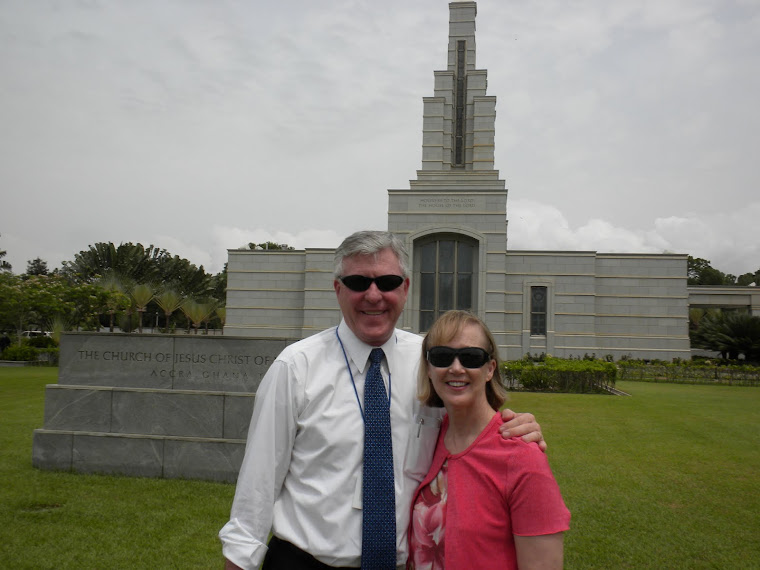
Accra Ghana Temple

Accra Ghana Temple
Accra Ghana Temple

Sunday, January 23, 2011

Something Fishy

One of the things you really must do to understand the food chain in Africa is visit one of the local fish markets.  During our visit to Elmina Bay we watched the fishing boats come in from night fishing.  We watched as they lifted baskets full of fish from the boats to the market.  We paid the 30 pesua (about 20 cents) fee to enter the fish market to see what they caught and who was buying.

This market was a huge concrete slab with little tables everywhere.  The buyers would select various fish and then sort by type and size for resale.  There were tables full of Red Snappers, crabs, prawns, rays, cuttle fish, squid, small fish, big fish, and even a 5-6 foot swordfish.

Gregg wanted to buy some fish, but we did not have a cooler to keep them until we got home.  We decided we would buy whole fish because we saw the machetes they used to cut the fish up!  It looked like the same machetes have been used forever without being cleaned.  And ditto for the little tables.

We tried to take pictures of everything, but some people would not let us.  Interestingly enough, some wanted to charge us for taking the picture, and some thought it was just fine.  

Sunday, January 16, 2011

Elmina Bay Fishing Boats

One of the best parades in Ghana is the return of the fishing boats.  At 7 or 7:30 in the morning you can watch the fleet of fishing boats return from night fishing to Elmina Bay Harbor.  Calling them a "fleet of fishing boats" is a bit of a stretch.  They are really nothing more than dugout canoes or small boats with small motors.  It still amazes me that they will take those boats out on a pitch black ocean where they will fish all night.  This is especially true knowing that most locals do not swim. 

The best place to observe this parade of colorful boats is from the arch bridge near the Elmina Slave Castle (see our previous blog entry).  Apparently each of the boats are owned independently and the captain takes great pride in coloring his boat, naming his boat and adding an appropriate scripture on the side of the boat.  The flags are beautiful.

As the boats work their way in they use their little motors and long sticks to maneuver through the maze of boats.  Sometimes they need a tow from a neighbor to fit in a place to dock.  Their clothes from the night of fishing are usually completely soaked and are often hanging on a clothesline to dry.  There may be 6 or as many as 10 fishermen per boat.  They do this 6 days a week, 52 weeks a year (there is no fishing in Ghana on Tuesday).  It is their life.  They are amazing. 

Sunday, January 2, 2011

The Canopy Walk

Ghana has some wonderful virgin rain forests.  Kakum National Park is just such a place.  In order to make the rain forest more accessible here, they have created rope bridges through the tops of these giant trees and call it "The Canopy Walk."  The Canopy Walk is 40 meters above the ground and makes for some great bird and butterfly siting.    


Gregg and I had heard so much about it that we took a day to visit the Canopy Walk and were not disappointed.  Getting to the Canopy Walk is another exciting experience because there are very few road signs in Ghana. We got instructions from those who had been there. This included hot tips like, "when you come to the fork in the road take a left" (we found several forks) and "watch for the turn off sign, there's only one."


It was a public holiday, which may have been a small mistake because many schools used it as a field trip to the Canopy Walk.  So we got to share this beautiful experience with some school children.  But all in all, we really enjoyed it.  We saw some amazing butterflies.  Our guide told us that the day before while leading a Nature Walk he spotted a Black Mamba (for those of you who are not snake aficionados, this is a seriously deadly snake).


You don't even have to climb to get onto the walkway. It starts at ground level, and as you walk along, the land below you slopes into a valley, and you find yourself twelve stories up in the forest canopy. The horseshoe-like pattern of bridges—made of steel cable, netting, and narrow wooden planks—are connected by tree platforms that serve as observation points for viewing the rain forest. You circle back to complete your tour on level ground.

The slight swaying is intimidating, but it's an incredible sensation to walk along it. The experience is pure adrenaline, and is definitely not for people with a fear of heights.

Monday, December 27, 2010

The Fruit Bats Are Here!

I've been waiting for this since the day we moved to Ghana -- the return of the fruit bats, sometimes called flying foxes.  The fruit bat has an excellent sense of smell.  While many people believe all bats are blind, fruit bats are really the only bats that do not have the best sight; they mostly do everything with their nose.  And they eat fruit exclusively.

Ghana has a large number of endemic bat species. It is nearly impossible to not see a colony of the Straw-colored Fruit Bats. They roost in trees and in the early morning they are quite noisy as they squabble over branches to roost on. There is a huge colony of perhaps 2000 individuals that make their home in trees near the 37th Military Hospital in Accra.

It was really fun for me to drive down Independence Avenue on my way to the Accra Temple and see the thousands of fruit bats roosting in the trees near the Military Hospital. Accra is in their migration pattern and at some point, they will move on and return again next year.

The locals tell the following story.  There once was a king who became very sick and was brought to the Military Hospital in Accra.  The bats loved him very much and flew to Accra to be near him.  The king eventually died there.  But no one told the bats - so they return every year to this same location.

There is a large tree near the swimming pool of our gated community.  We were told that the bats loved to roost there, but because they created such a mess, the gardeners cut the tree back drastically and the bats have abandoned this location.  However, during one of our morning swims we saw hundreds of bats swarming in a neighboring yard.  That was close enough for me.

Tuesday, December 21, 2010

Dodging Malaria

In America, we have mosquitoes that are big and loud.  You can hear them coming.  You can feel them land and slap them while still on your skin.  Not so in Africa.  The Anopheles mosquito is very tiny, quick, and silent - the perfect predator.  You will only find out later, maybe the next day, that you've been that mosquito's lunch.  

The female Anopheles mosquito is the "bad boy" that transmits the parasites that cause malaria. They start biting in the late evening, with the peak of biting activity at midnight and early hours of morning.  The specific species of Anopheles that causes all this trouble in in Africa is called A. gambiae. The Anopheles female mosquito lays 30-150 eggs every 2-3 days and the average life span of these critters is 2-3 weeks.  Sadly, every 30 seconds a baby dies of Malaria in Africa. 

Studies claim that mosquitoes choose their victims by odors and human behaviour.  Also it is believed that males are more frequently bitten.  Can that really be true?  Gregg said "no way is that true," because Shannon always has more mosquito bites than I do. 

We are currently on a preventative regimen of Doxycycline.  This is to create a hurdle for Malaria; maybe even disable it.  We also carry, at all times, a box of Artrin which is to be taken immediately if malaria symptoms appear. Artrin is very effective in eliminating the parasites. It is possible for  Malaria to manifest up to a month after being bit.  The telling symptoms are chills and fever, headache, tiredness, nausea, vomiting and diarrhea.  I am told that you get really sick really fast.  Not fun at all.     

All the missionaries in the West Africa Area are given a mosquito net and 2 new commandments; use the net every night and to take Doxycycline daily.  If they follow these guidelines, they can avoid malaria - virtually guaranteed.  They are also encouraged to give the mosquito net to a mother for her baby when they return home. 

It gets dark here by 6 p.m.  We really try not to be out at night to avoid the mosquitoes, so if we do go out at night we use DEET mosquito repellent.  We have a pest control plan for our home and we do our best to keep our house sealed up. We also protect ourselves in the evenings and early mornings by wearing clothes that cover the body as much as possible.

If it can be done, we plan to leave Africa having never experienced Malaria.  Wish us luck.

Sunday, December 5, 2010

Thanksgiving Ball

Gregg and I were assigned to represent the Church at the Thanksgiving Ball sponsored by the American Chamber of Commerce, Ghana Chapter.

As it was a black tie event, Gregg found a tailor who made a wonderful tuxedo for him at a reasonable Ghanaian price (this would have cost a mint in the United States, not here). I had only one request of the tailor; make him look like James Bond.  And he did!  Finding a tuxedo shirt and a cummerbund was another challenge.  They just don't sell them here, and certainly not in Gregg's size; fortunately our tailor had a European contact that found what we needed. 

I was still in America when we received the invitation.  Gregg told me to pack a gown.  I could only imagine what it would look like when I landed in Accra.  To my amazement, it was just fine. 

We attended the Thanksgiving Ball held at La Palm Resort and had a wonderful time. 
Entertainment was by the Zuum band which seemed to us to have a Caribbean flare. 

This was a great opportunity for us to meet local dignitaries.  We also met the US Ambassador and other US Embassy officials which can be of great help to the Church here.   

Sunday, November 28, 2010

Going native in the Kitchen

As I said in my last blog, a Ghanaian  church member agreed to teach me to cook some local dishes, which led us on our adventure to Kwame Nkruma Market.  At the market we acquired the following ingredients:  okra, tomatoes, green beans, carrots, onions, green onions, little white eggplant, cabbage, Ghanaian spinach, a medium sized smoked salmon (or a salmon-like fish), red cooking oil, tomato paste, and some mystery dough.

After my arrival home from shopping with this bounty, I washed and then rinsed in bleach all the items, including the can of tomato paste and the smoked fish.

The following day she arrived for my cooking lesson.  Our biggest disconnect was my need to measure items in teaspoons and cups, which is absolutely foreign to them.  Recipes happen based on "look, smell, and experience."  When I began to record the steps of our cooking and asked her how many cups of rice we needed, I got a polite smile and a muffled giggle.

We made Jollof Rice - which contains onions, tomatoes, tomato paste, small green chiles, small red chiles, garlic, ginger (African ginger is HOT), fish, rice, cabbage, green beans, carrots, green onions, bell peppers, oil, and water.  It is a 2 hour process, but very worth it.  We made enough to feed a small army.

We also made Okra Stew.  Okra are season right now and you see them everywhere.  I'm very fond of fried okra.  You can't find that here.  For this dish we used a chicken, onions, small green chiles, ginger, garlic, 20 chopped okra, 10 garden eggplant (imagine very small white eggplant), African spinach, red oil (palm oil), salt, bouillon and water.  This dish took an hour to prepare.  Boiled okra is slimy, no matter how you cut it, so you'll just have to imagine that when you think about eating this.

Making fufu was a bit like making play dough. To begin, I mixed together with my hand the cassava, maize and water to a smooth consistency (like making mud pies as a girl). Then we began to cook it, stirring constantly as it changed color (from white to light yellow) and thickened. I was amazed how much work it was to beat this dough as it cooked. I was cautioned that you must always cook this at least 40 minutes or you will get terrible diarrhea. Having received the warning, I cheerfully continued to cook and beat the dough.

I invited her to stay for dinner. She had to go before Gregg would get home, so she ate immediately. The way the locals eat this meal is with their hands, which was fine with me. It was very interesting to watch her pinch off the dough and dip it in the Okra stew. She was very pleased with the outcome of our project. Gregg, who will eat just about anything, thought it was great!