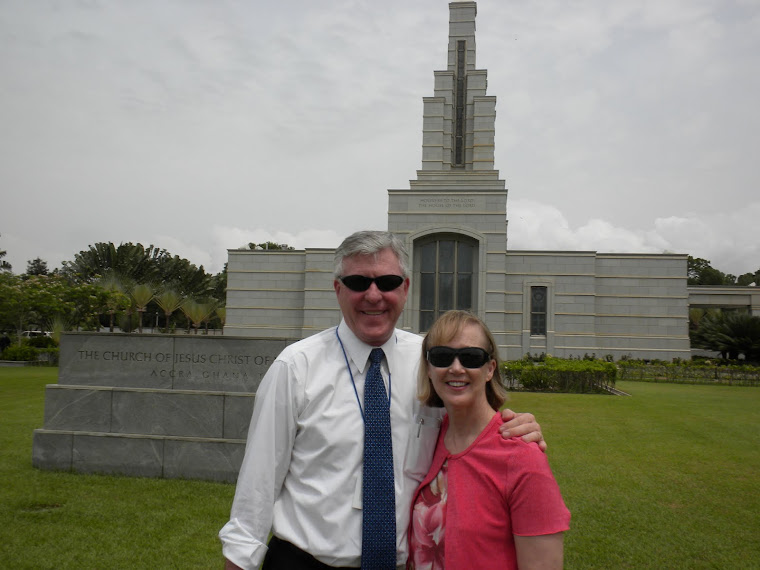
Accra Ghana Temple

Accra Ghana Temple
Accra Ghana Temple

Thursday, March 17, 2011

The Vultures at Busua Beach

We heard that the best beach in Ghana is Busua Beach.  It is about a 5 hour drive west of Accra.  So, you really have to want to go there.  You probably also need a 4 day weekend or more to make it worth the drive. 

And we found it to be all that it is reputed to be.  It is a beautiful beach that stretches far and wide.  There is a little island with 2 palm trees out in the water, more scenic than something you really need to visit by canoe or kayak (but you can). 

The sand slopes very gradually from the beach. The waves are particularly great.  As a last thought to our packing, we tossed in the Boogie Boards.  We seem to have retained all that our children taught us on the beaches in California years ago.  We had such fun.  It felt like you could ride the wave forever before you got to the beach.


On one of our beach walks we headed toward a large group of birds.  They were too far away to really distinguish.  As we got closer,  we realized that they were vultures.  They thought we were interesting, but allowed us to come within feet of them and never scattered or took flight.  We got to see how they dry their wings by holding them open to the wind.  And, yes, they were feasting on gifts from the fishermen.  Bon apetite!     

Sunday, March 13, 2011

A Troop of Baboons

Yes, a bunch of baboons is officially called a "troop" of baboons. 


We were driving with Elder and Sister Dickson to attend Sunday Services in Kpong, Ghana. We had been driving for 45 minutes.  Imagine our complete surprise when we noticed something dark in the middle of the road ahead.  As we got closer, it was in fact a troop of baboons, feasting on breakfast.  A box had fallen off a truck onto the side of the road and apparently had some good pickings.

It was interesting to see right up close just how big they are.  They were totally unafraid of us or the cars going by.  We did not get out of the car, but got a few good pictures.  It was adorable to see the little ones clinging to their mothers as they crossed the road.  They all seemed very savvy about traffic in the road.   We also observed some grooming behavior.  

Imagine living with the same group of people for your entire life. Not just staying connected to the same group through letters and phone calls, or even sharing a house with someone for your whole adult life, but literally being within 100 meters of the same set of people from the time you are born until the time you die.

For humans, of course, this is unimaginable. Even the closest family separates during the day to their various jobs and schools, and kids grow up and form their own families in their own homes. Baboons, however, live their entire lives in close and continuous proximity not only to friends and family but also to opponents.  That makes for some interesting dynamics.

Tuesday, March 8, 2011

Well Kept Secrets of Preparing Tropical Fruit

By popular demand, I am going to share with you some inside secrets of cutting tropical fruit and how to tell when they are ripe. 

Mangos stay green and feel firm as they ripen.  I judge when they are ripe by the smell.  When they smell fruity and wonderful, they are ripe.  If you don't plan to eat it today, place it in the refrigerator where it will stay very well 2-4 weeks.  This is a BIG one from our mango tree in the backyard.  How fun is that?

The easiest way to cut a mango is to forget about peeling it.  Stand the mango on end and begin at the top to slice along the oblong seed (so you are basically cutting it in half).  Then take that half and score the inside (all the way to the peel) into squares the size you like.  Then use a spoon and scoop out the squares.  If for any reason the mango gives you grief, you can flip it (like this photo) inside out and use a knife to cut off the squares. 

Papayas turn from green to slightly yellow and begin to soften when ripe.  Get ready to cut it or place it in the refrigerator where it will stay ready for 2-4 weeks.     

The easiest way to cut a papaya is to cut it in half the long way.  Use a small spoon to scoop out the seeds.  Scoop until there is a smooth surface.  Then score the inside into squares (all the way to the peel).  Use a spoon to scoop out the squares.  Basically it is the same as a mango, except the seeds come out differently.

Now for pineapples.  First test the ripeness by trying to pull out one of the top inner leaves.  If it is ripe, the leaf should pull right out.  And certainly the pineapple begins to turn yellow as it ripens.  You can also smell the bottom of the pineapple checking for a sweet, almost flowery aroma.  Once ripe they keep well in the refrigerator uncut.  Some recommend turning the pineapple upside down for at least 30 minutes before cutting.  This is supposed to redistribute the sugar inside. 

There are two schools of thought on cutting pineapples.  I will tell you the easiest way for me.  I like the sweet white Cape Coast Pineapples, with the soft edible core.  First, cut off the top and the bottom, leaving a cylinder shaped pineapple.  Now cut the pineapple in half longways.  Cut each half again longways.  Cut each fourth again longways, leaving 8 long wedges.  Use a carving knife and slice between the peel and the fruit.  You can cut off the core from each wedge if desired.  At this point it is very easy to cut the fruit into wedges, tidbits, or leave them as spears.

The cut fruit will easily stay fresh in the refrigerator for a week, so enjoy!      


Tuesday, March 1, 2011

Visitors from Salt Lake City

For the last 10 days, the Africa West Area has been priviledged to host Elder Dallin Oaks, Elder Gonzalez, and Bishop McMullin and their wives as they have completed a review of the Area.  The really fun part for me was attending the Auxiallary Training in Lagos, Nigeria taught by Sisters Oaks, McMullin and Gonzalez.  The training was for the Primary, Young Women and Relief Society Leaders and these sisters did a wonderful job of lifting, teaching and training the sisters.  The Area Presidency wives also attended.  Elder Oaks came in for part of the training and spoke to us.

I am happy to report that Gregg has survived the marathon of doing the logistics, preparing the venues, and taking care of all the details.  I had no idea just how many plates this man could keep spinning!  The area review began at Port Harcourt and then Abuja, Nigeria (the capital) for the first weekend.  This was followed by a visit to Accra,Ghana during the week and the last weekend concluded in Lagos, Nigeria.

I attended Stake Conference at the Lagos West Stake, where Elder and Sister Oaks spoke.  I was also at Member Devotionals (they are not firesides any more - so you can stop wondering just where the fireplace is) in Accra, Ghana and Lagos, Nigeria.  For me, part of the fun of attending these meetings was seeing the amazing headwraps some of the sisters wear.  They are absolutely stunning! 

I also attended Employee Devotionals in both locations. About 1/4 of the Ghana employees sing in the Employee Choir. Their music was amazing; before, during and after the devotional.  During all of these meetings, we were reminded that the Lord is doing a great work among His children in West Africa whom He loves so much.   We heard some very powerful testimonies of Jesus Christ and His Atonement.  It was a spiritual feast!

This was a week of firsts for me:  first Area Review and my first trip to Nigeria.

Saturday, February 19, 2011

I love you like a Mango

In case you haven't heard this catchy tune, it's for real and our granddaughters can sing it for you upon request.  Seriously, the fruit in Ghana is too wonderful for words.  We love the Cape Coast pineapples, the tiny sweet bananas, and the glorious mangos that grow on the big tree in our backyard. 

When I hold one of these mangos you can't see my hand underneath because it is that big.  If I could eat a mango every day of my life I would die a very happy woman.  Since we will not be making strawberry jam here any time soon, I promised to make Gregg some mango jam in Africa.  Well, it is mango season and I gave it a first attempt.  Luckily, I brought Sure Jell from America because I won't be finding that in Accra.  Because our tree is tall, picking the mangos can be a challenge.  We even employed the pool skimmer as a "catch basket" and it works!  Each mango grows at the very end of a branch.    

The young banana tree in our backyard had 3 leaves when we arrived in July.  It now has 9 leaves and we hope to live here long enough to experience a harvest like our neighbors.  We've also become plantain fans.   Our favorite is fried plantains; some people prefer boiled.   

This cocoa bean tree was intriguing to watch as the pods grow right out of the trunk.  Ghana is the #2 exporter of Cocoa beans in the world.  Valentine's day here is National Chocolate Day in celebration of that fact.  There is a whole science to drying and roasting the cocoa beans.  Their chocolate bars remind me of baking chocolate.

The Cape Coast pineapples are white inside and the core is so soft that you eat it too.  They are tall, thin and delicious.  I can no longer imagine our kitchen table without a pineapple ripening in the fruit bowl.       

Sunday, February 13, 2011

The Harmattan Winds Have Arrived

The harmattan has arrived in West Africa!  We had heard about it, but we had not personally experienced it until now.  The Harmattan is a dry and dusty trade wind. It blows south from the Sahara into the Gulf of Guinea, off and on, between the end of November and the middle of March.  On its passage over the desert it picks up fine dust particles and carries them to our doorstep.  It reminds us of a bad air inversion day in Salt Lake City.

The word "harmattan" comes from the Twi dialect which is widely spoken in West Africa.  As early as 1671 English adventurers spoke of the harmattan.  And it is one of the few words of Twi that have entered the English vocabulary.

At its worst, the heavy airborn dust can severely limit visibility and block the sun for several days, comparable to a heavy fog. The effect caused by the dust and sand stirred by these winds is known as "harmattan haze."  On bad days it can costs airlines millions of dollars in cancelled and diverted flights.

Humidity drops very low during the harmattan and locals can experience nosebleeds, as they are used to humidty in the 90% range.  Now we know why we brought lotion and chapstick! 


Some people say that men and animals become increasingly irritable when this wind has been blowing for a while, giving it a bad reputation. However, some feel the cool wind brings relief from the oppressive heat, which is why the harmattan, in some places, has earned the nickname "The Doctor." 


So far, it has been a mild harmattan season.  When we flew into Accra Jan. 14, the haze was almost eerie and we didn't see the sun for days.  Temperatures were cooler and the humidity was lower.  We even got goose bumps when we went swimming.  However, most of February has been clear, warm and humid.

Sunday, February 6, 2011

Jerusalem

Gregg was asked to come to regional meetings hosted in Jerusalem, Israel.  This was too good to miss, so we bought a ticket for me to come along.  We stayed at the BYU Jerusalem Center for Near Eastern Studies (or as it is called there, the Mormon University).  It sits prominently between Mount Scopus and the Mount of Olives with a gorgeous view of the old city of Jerusalem and the Temple Mount.  

To me, any day is a good day to be in Jerusalem, even in January when it is cold and rainy.  This is not the tourist high season which enabled us quick access to all of the special places we hoped to visit.  In between and after meetings on the few days we were there we visited the Western Wall and the Temple Mount.  We went to the Garden of Gethsemane, Orson Hyde Park, the Church of the Holy Sepulcher, the Pool of Bethesda (Saint Anne's Church), ruins of Antonia's Fortress (underneath some current buildings in the old city), Yad Vashem (the Holocaust Museum), Zedekiah's Cave (or King Solomon's Quarries), the Wohl Museum and the Burnt House (ruins of elite Jewish homes at the time of Christ).  We walked the Via Dolorosa (the "way of pain") from the old city to Golgatha.  

We particularly enjoyed our visit to the Garden Tomb where Bishop McMullin addressed us.  The door to the tomb reads "He is not here for He is Risen."  On Saturday, their Sabbath, we drove to the Sea of Galilee and worshipped with the LDS Branch of Tiberius.  We traveled to Peter's Primacy where we read some scriptures, visited the ruins at Capernaum where Gregg gave a short discourse of Christ's teachings at that location, and then held a testimony meeting on the Mount of Beatitudes. 

The trip was over all too quickly.  Even though we have been to Jerusalem before, we deeply appreciated the opportunity to reconnect with the places where Jesus lived and taught.  It makes it easier for us to remain committed to our efforts here in West Africa when we remember what happened in the Holy Land over 2000 years ago.