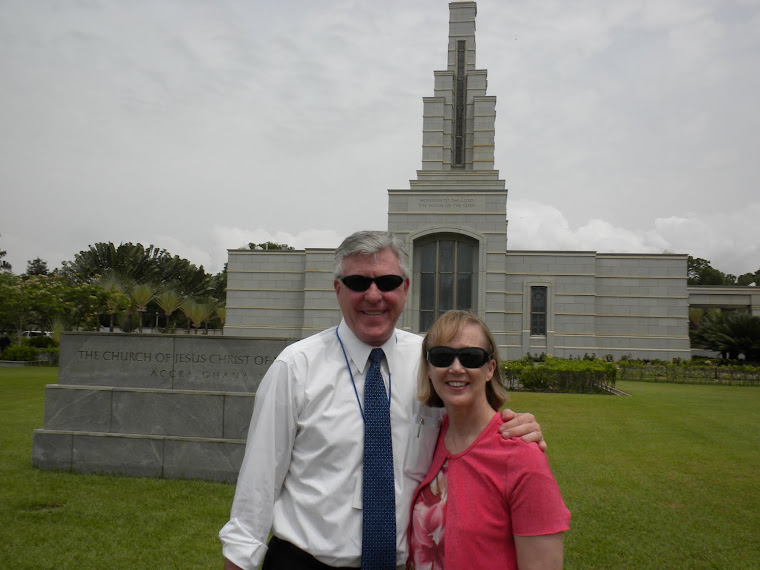
Accra Ghana Temple

Accra Ghana Temple
Accra Ghana Temple

Saturday, September 11, 2010

What a Shock - My Electrical World

We fully understood that in coming to Africa, we were leaving the world of 110V electricity and entering the world of 220V.  We brought with us adapters, converters, and step-up/step-down units.

The surprise to us was that Ghana is the United Nations of electrical plugs.  We have electric appliances from Europe, South Africa, Asia, the United States, and so on.  Our home is built for UK style plugs.  Our appliances are rarely from the UK.  So we are always searching for what kind of an adapter will allow us to plug what appliance into the wall. All wall sockets have their own on/off switch at the wall. Since a picture is worth a thousand words, you can have a close up look at our electrical world. 

For the US appliances and electrical equipment we brought, we have to step-down the voltage from 220 to 110.  We have several varieties of converters which can accomplish this.  But if you forget... it is the sudden and sure death of your US electrical toy (if there is not a built in converter in your US appliance).  For example, most computers have that built into the power system.  

The second problem is electrical surges which are all too common here.  In order to protect your equipment, you must have a voltage regulator.  It will stabilize the flow of electricity to 220, even if spikes occur.  So, your sewing machine would need a voltage regulator or it could become toast!

The third problem is the frequent power outages.  We are very blessed to have a large diesel operated generator in our back yard.  When the electricity goes off, this behemoth roars into activity.  We usually have a quick return of lights and power unless there is a problem with the generator... which has happened... and then Gregg and I sit in the dark.  Fortunately, our computers function with a battery backup, so we don't lose anything during a power outage. 

Leapin Lizards!

Our small guests, the common house geckos (hemidactylus mabouia), are not to be underestimated in their jumping and running abilities.  This week I opened the cupboard to take out plates for dinner.  Peering over the top of the plate, were two tiny black beady eyes;  a baby gecko.  As I reached for the plates, he leaped out of the cupboard, onto me, and made a safe landing and a quick getaway on the floor. I was so proud of myself for not dropping the plates. Gregg said, "well done, Shannon." The happy ending is that the next morning when I opened the door, there he was ready to run for his life.  Free at last! 

These little translucent bug-eyed lizards are small and bland compared to the Rainbow Lizards which live in our yard and just about everywhere in Ghana.  The males have a bright yellow or orange colored head and bands of colors down the length of their body.
The females are smaller and smarter by blending in very well with their surroundings, usually matching the dirt or rocks.  These lizards have the most unusual characteristics of sprinting, looking around quickly with their buggy eyes, and then doing a series of fast push ups.  We're not sure what they're trying to tell us.  Perhaps it's "look how strong and buff I am!" Gregg thinks they are just showing off for the female lizards.   

Rarely will they let you get close enough to snap a picture.  I like to think I'm quick with the camera, but it was probably just a case of a lizard with an inflated ego that wanted a picture of his push-ups.  We like these lizards because they make a steady diet of bugs.   

Saturday, September 4, 2010

Elmina Slave Castle

During our recent trip to Cape Coast and Elmina, we visited the very sobering Elmina Slave Castle.  The white-washed, red-roofed castle with its many cannons facing the sea sits right on the ocean.  The grand scale and picturesque views belie the horrors that took place there.  This is oldest and largest of many slave castles that exist along the Gulf of Guinea (also known as the Slave Coast).   

Elmina was built on sedimentary rock believed to be over a hundred meters deep, thus explaining why it is in such good condition today.  The castle was isolated from the community with moats, over which spanned a drawbridge, allowing no one to enter of leave the castle when lifted.  The Portuguese built Elmina Castle in 1482 as a trading post to house goods bartered (like guns, ammunition, tobacco, alcohol, and spices) for local gold and ivory.  As the demand for slaves developed in South America (Brazil), the Caribbean Islands, and America, the castle began to store a more precious and perishable trade - African human slaves. 

Millions of Africans were taken into slavery between the 1500s and 1800s.  The slaves were traded or sold to Europeans sometimes by their own chiefs, by a victorious warring tribe, or native African raiders.  Elmina castle could hold 600 men and 400 women and children (over age 12) for months at a time, waiting for the ships to arrive.  The cramped conditions had to be atrocious. 

The most sobering location in the castle was the "Door of No Return."  A barred door opens to reveal a narrow opening, only wide enough for one slave at a time to fit through sideways.  As they left the castle on small boats bound for the ship, this would be their last view of Africa, their homeland.  Half died on the voyage, but none ever returned.  It is hard to believe what humans can do to each other.
Sunday, August 29, 2010

Road Trip to Cape Coast

This weekend we made our first road trip out of Accra to the resort town of Cape Coast and the neighboring fishing village of Elmina.  This is a very lush green area of Ghana with picturesque villages and beaches.  The real adventure of the trip relates to the lack of road signs for highways and streets.  There were signs identifying most of the villages, which was the only clue.  

Getting to our hotel was a bit unnerving to say the least.  After driving through the small fishing village of Elmina, the paved roads with potholes came to an end.  As we followed the red dirt road with high vegetation on both sides, we asked ourselves, "could this be right?"  Then we saw a sign directing us to our hotel and made the poor assumption that we were almost there.  WRONG.  Just as we were about to turn around thinking that if there was a hotel out here, we weren't sure we would stay at it - we found a very lovely and new hotel on a beautiful beach with a hundred coconut trees.  It was delightful to sit by the pool or in the open air restaurant and enjoy the crashing of the waves.  At the restaurant we enjoyed wonderful fresh seafood.  The grouper, snapper, and lobster were outstanding and reasonably priced. 

It was interesting to see villages made up of huts which were mud bricks with grass roofs.  The traditional shape of the huts is round, but the newer ones are rectangular. We saw many Brahman cattle being herded along the seashore.  The fishing villages were fascinating; ladies were selling live crabs, shrimp, and fish of every variety including smoked fish.  We saw the mud brick ovens with screen racks on top used to smoke the fresh fish caught that day.   

The drive through the small fishing village of Elmina was filled with amazing sights, sounds, and smells that are difficult to describe.  All the homes were made of wood or mud bricks, a very few had block walls.  We were sharing the narrow road in Elmina with goats, chickens, pigs, sheep, and children.  All the boats were made from wood; some were nothing more than dugout canoes.  All go out to sea for fishing with nets.  As we drove along we happened upon two white-shirt and tie Elders teaching a man in front of his very simple home.  

We attended church with the Ola Ward in Cape Coast. The meeting was conducted in both English and Fante (the local dialect). The Bishop was making the announcements in Fante. And suddenly in English he said, "and would the white couple in the back stand up and announce yourselves," which we did. We were a little surprised but felt warmly welcomed.

Gregg saw what looked like someone holding a dead rat by the tail at the side of the road.  Guess what?  They were selling a dead rat!  Among bush meat delicacies is the highly favored Cane Rat also known here as a Grasscutter.  This particular man had caught the rats, cleaned and smoked them and was offering them for sale to passing motorists.  We were not tempted to buy one, but paid $1 to take a picture (we just had to have a remembrance of those teeth).  On arriving home we googled Grasscutter and found it is genus thryonomys syinderianus with numerous tasty recipes including Grasscutter stew.  Darn, I guess we missed our chance. 


A Mighty Change

By assignment from the Area Presidency, Gregg and I went to Cape Coast to represent them at a youth production called "A Mighty Change."  This pageant occurred August 28, 2010 in each country of the West Africa Area; and in some cases, at several locations within a particular country.  The same pageant was occurring in Accra simultaneously with the one we attended in Cape Coast.  The Cape Coast production included youth from 3 stakes and 2 districts (about 1200 youth).  

As we traveled to Cape Coast we took 1200 neon green t-shirts imprinted with "A Mighty Change" to be given to each young participant as a remembrance of this day.  The production ran for about 2 1/2 hours.  It was well done with a very professional sound system.  The venue was the very prominent town square which had  been prepared with chairs for the audience, mats for the youth to sit on, and canopy coverings for all.  There was a nice cement stage with stairs.  The curtain was suspended on a rope and worked by manual operation of the stage crew.  The costumes were colorful and handmade. Our favorite was the sheep.  The play depicted scenes from the Book of Mormon, including Ammon protecting the King's sheep.  

We were particularly glad about this performance for 3 reasons:
  • Youth from a large geographic area were able to get together with other youth who believe as they do.
  • These youth will remember the truths of the Book of Mormon from the scenes they portrayed.  
  • The whole thing succeeded due to a strong coordinated effort by local Priesthood leaders; pulling something together that was very nice.     

Sunday, August 22, 2010

Gecko Catch and Release Program

There are the cutest little white geckos here.  We have found a couple inside our home.  We really don't mind them, but due to the very effective fumigation program, they don't stand a chance at co-habitating with us. 

The most memorable was the occasion when we were getting ready for bed and Gregg said, "there's either a new pattern in the middle of our bedspread, or that's a gecko."  And indeed it was a gecko.  I grabbed a plastic bowl and sent Gregg for a piece of cardboard.  With my lightning quick reflexes, and coming up from behind (as suggested by Gregg) I captured him under the bowl.  We slid the cardboard underneath and then released him outside in the bushes.  Boy was he fast!  As he dashed off, Gregg commented, "I hope you live a long life, who knows, maybe one day you'll end up in an insurance commercial."

The other one was a religious sort, dashing behind the picture of Jesus Christ for sanctuary.  Gregg was out of town in Sierra Leone, so I was on my own for a successful capture and release.  

We've included a picture of a 4 inch gecko that lives on our back porch. 

Helping Hands - All Africa Service Project

August 21, 2010 was the All Africa Service Project.  Members of the LDS Church from all across Africa donned yellow vests and gave their Saturday for service in local community projects.  Gregg and I worked with the OSU Ward and cleaned up the OSU Market with local OSU Tribal group.

Our bright yellow vests had two green hand prints and read, "Mormon Helping Hands"  and "The Church of Jesus Christ of Latter-day Saints."  Everyone was very happy to wear these vests.  Gloves were a must as you will see from the description of our project.  I was given a pair of bright yellow gloves which was just the ticket. 

We met at the OSU Ward Chapel and later discovered we would embark on a 2 mile hike to and from the OSU Market.  With Gregg's 5 week old knee arthroscopy and my plantar fasciitis, we were quite the limping duo on our hike.  

The OSU Market desperately needed our help.  They sell everything from recently made charcoal to fruits and vegetables.  There were even a couple of "hair boutiques" complete with a chair for the client and a portable hair washing station.  Some people appeared to live there.  They had some less than desirable showers and we were warned not to go near one wall as that was apparently the bathroom facility.

We filled numberless black garbage bags full of garbage and trash.  The OSU Tribal Stool (tribal council) had arranged for a garbage truck to haul it away.


The funnest part were the little children that apparently lived at this location.  One two year old girl followed us around and "adopted " one of our brooms that she wanted more than anything.  The children were quite happy to jump right in and begin helping.

At the end of the project, Gregg was completely soaked with sweat, not a dry stitch of clothes on him (high humidity in Ghana).  We treated ourselves to a meal at a "fast food" restaurant, which in Ghana usually means fried rice and chicken in under 45 minutes.